


PROLOG OPTICS
Representative company that specializes in providing consulting solutions in the field of electro-optics.
PROLOG OPTICS
Prolog Optics is a representative company that specializes in providing consulting solutions in the field of electro-optics.
Established in 1996, we have consistently demonstrated our strong market presence, thanks to our exceptional salesforce team and extensive industry experience.
As an exclusive representative of leading international companies in Israel, we take great pride in offering premium components and solutions to a diverse range of sectors, including Semiconductor, Defense, Medical, Automotive, Security, R&D, and more.
Our mission at Prolog Optics, is to collaborate closely with our valued customers, surpass their technical expectations, and deliver cost-effective, efficient solutions within project timelines.
Semiconductor, Defense, Medical, Automotive, Security, R&D, and more
- Speckle Reduction in Laser-Based Optical Systems
- EssentOptics Advances Polarization-Resolved Metrology of Optical Coatings in the Deep UV
- Edmund Optics Expands Availability of HOLO/OR Beam Shaping Optics for Laser Applications
- Excelitas Introduces pco.dimax 3.6 DS ST CLHS High-Speed Camera for Double-Shutter Imaging
- LUCID Introduces Atlas10 SWIR Cameras with 10GigE and Integrated Cooling
Speckle is a fundamental limitation in many laser-based optical systems.
Even when a system is fully functional, speckle noise can prevent it from reaching the required level of performance in terms of accuracy, contrast, and repeatability.
In applications such as optical metrology, imaging, and inspection, these effects are particularly critical.
The coherent nature of laser light leads to interference patterns that manifest as granular intensity variations, commonly referred to as speckle. These artifacts can degrade image quality and introduce measurement uncertainty, especially in high-resolution or high-sensitivity systems.
In practice, speckle-related limitations are often not immediately visible.
They tend to emerge at later stages of system integration, after optical alignment, source optimization, and signal processing have already been addressed. At that point, mitigation becomes more complex and costly.
Origin and System Impact
Speckle is inherently linked to coherence.
When coherent light interacts with surfaces or propagates through optical components, small variations in phase lead to constructive and destructive interference. The result is a spatially non-uniform intensity distribution.
From a system perspective, this translates into:
- Reduced measurement accuracy
- Lower image contrast
- Decreased repeatability
- Sensitivity to alignment and environmental variations
Because speckle is not simply noise but a physical interference phenomenon, it cannot always be removed through post-processing alone.
Dynamic Speckle Reduction
One of the most effective approaches to reducing speckle is dynamic averaging.
In this method, multiple independent speckle patterns are generated and averaged over time.
This reduces the perceived contrast of the speckle, leading to a more uniform intensity profile. The effectiveness of this approach scales with the number of uncorrelated patterns that can be averaged within the detector’s exposure time .
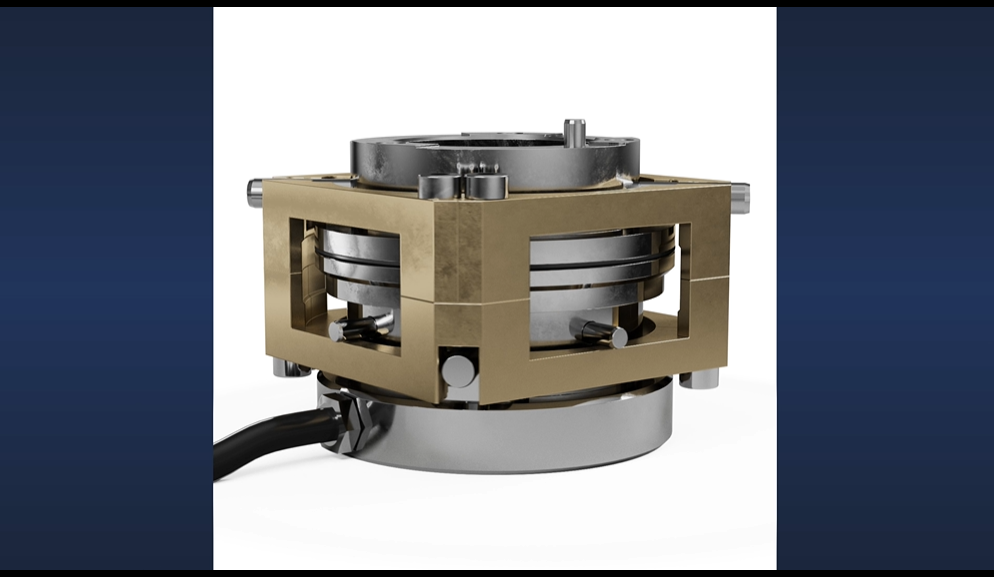
A common implementation involves the use of a dynamically actuated diffuser.
By moving the diffuser at high frequency, the system continuously modifies the phase distribution of the beam, generating different speckle realizations that are temporally averaged by the imaging system .
Practical Implementation
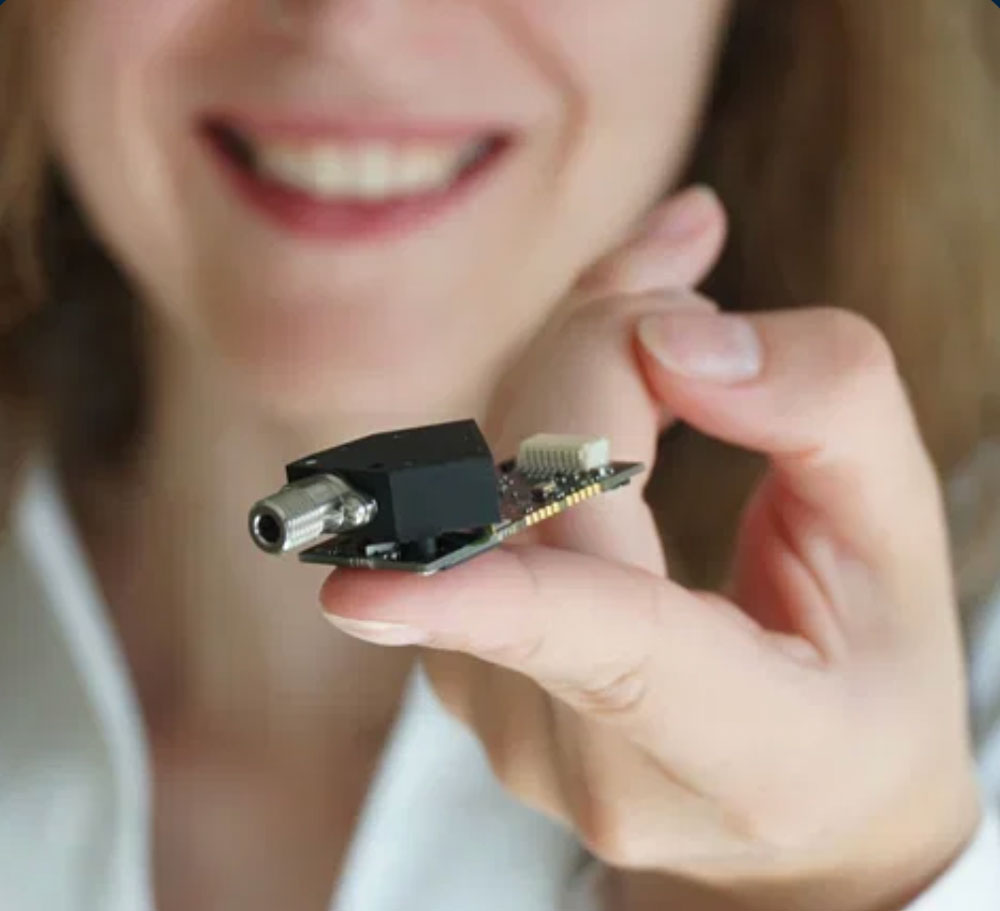
Technologies developed by Optotune are based on this principle.
Their laser speckle reducers use compact, dynamically driven diffusers to average interference patterns and improve beam homogeneity. These systems are designed for straightforward integration, with compact form factors and integrated driving electronics, making them suitable for a wide range of applications including metrology, microscopy, and projection systems .
Compared to static diffusers or mechanical alternatives, dynamic solutions offer:
- More efficient speckle contrast reduction
- Better control over system parameters
- Compact and integration-friendly designs
- Improved long-term stability and reliability
System-Level Considerations
Speckle reduction should be considered as part of a broader system-level design strategy.
Its effectiveness depends on multiple parameters, including:
- Optical layout
- Beam diameter and divergence
- Diffuser characteristics
- Motion frequency and amplitude
- Detector exposure time
Optimizing these parameters requires coordination between source selection, optical design, and system integration.
At Prolog Optics, speckle reduction solutions are evaluated in the context of the full optical system, where beam quality directly influences measurement reliability and overall performance.
👉 Learn more about laser speckle reduction solutions by Optotune
👉 Contact us for pricing, availability, and technical support
EssentOptics presents an approach for polarization-resolved metrology of optical coatings in the deep ultraviolet (DUV) range, addressing measurement challenges related to accurate separation of S- and P-polarized components.
Characterization of optical coatings in the DUV range remains technically demanding, particularly at wavelengths such as 193 nm, 213 nm, and 248 nm, which are widely used in semiconductor inspection, laser micromachining, and advanced optical systems. Reliable measurement under these conditions requires accurate control of polarization and angle of incidence.
The EssentOptics approach is based on its PHOTON RT spectrophotometer platform, enabling broadband transmission and reflection measurements with variable angle and polarization control. This supports evaluation of coating performance under conditions that are closer to real operating environments.
Enhanced system configurations extend measurement capabilities into the deep UV down to approximately 185 nm, with automated acquisition of angle- and polarization-resolved data. The system enables separation of S- and P-polarization components and supports repeatable measurement workflows for coating characterization.
The measurement approach is designed to address limitations of conventional methods, where coatings are often evaluated at a single angle or without polarization control. By enabling angle-resolved and polarization-resolved measurements across a broad spectral range, the system supports more detailed analysis of coating behavior.
Key capabilities
- Polarization-resolved measurement of optical coatings (S and P components)
- Operation in the deep UV range down to ~185 nm
- Variable angle of incidence for angle-resolved characterization
- Broadband transmission and reflection measurements
- Automated measurement workflows with high repeatability
Typical applications
- Semiconductor inspection optics
- Laser micromachining and processing systems
- Optical coatings for DUV laser sources
- Scientific and metrology applications
- Advanced optical components requiring polarization-sensitive characterization
👉 Learn more about DUV metrology solutions on the EssentOptics website
👉 Contact us for pricing, availability, and technical support
Edmund Optics has expanded its portfolio with off-the-shelf beam shaping solutions from HOLO/OR, including diffractive diffusers and beamsplitters designed for use in laser-based systems.
These components are diffractive optical elements (DOE) used to modify the spatial intensity distribution of laser beams, enabling transformation of Gaussian beam profiles into defined shapes such as circular, square, or line patterns.
The HOLO/OR diffusers are designed to convert collimated laser beams into uniform intensity profiles with controlled distribution, supporting consistent energy delivery across the target area.
These components are designed for use with laser systems, including higher power configurations, and support stable intensity distribution in applications requiring controlled energy deposition.
Availability as standard, off-the-shelf components supports shorter lead times compared to custom beam shaping solutions and enables integration into existing optical systems.
Key capabilities
- Diffractive beam shaping using diffusers and beamsplitters
- Conversion of Gaussian beams into defined intensity profiles
- Uniform illumination across target areas
- Designed for use with laser systems, including higher power configurations
- Available as standard components
Typical applications
- Laser material processing (e.g., welding, ablation)
- Semiconductor and microelectronics manufacturing
- Medical and aesthetic laser systems
- Industrial laser-based processing and inspection
👉 Learn more about HOLO/OR beam shaping optics on the Edmund Optics website
👉 Contact us for pricing, availability, and technical support
Excelitas Technologies has introduced the pco.dimax 3.6 DS ST CLHS, a high-speed camera designed for capturing fast transient events using double-shutter imaging at high spatial and temporal resolution.
The camera provides 3.6-megapixel resolution (1984 × 1808) combined with double-shutter CMOS operation, enabling acquisition of more than 1,000 double images per second at full resolution. The double-shutter mode supports an interframing time of 250 ns, allowing precise measurement of rapid motion in dynamic processes.
The system uses a Camera Link HS (CLHS) fiber-optic interface to support real-time streaming of uncompressed image data over high-speed connections, enabling continuous acquisition and immediate data access.
The camera features a monochrome CMOS sensor with 11 µm pixel size and supports both global shutter and double-shutter operation modes. Configurable region-of-interest and binning options allow adjustment of frame rates based on application requirements.
Air-cooled and liquid-cooled configurations are available to support operation under varying environmental conditions.
Key capabilities
- 3.6 MP resolution (1984 × 1808)
- Double-shutter imaging with 250 ns interframing time
- Acquisition of >1,000 double images per second at full resolution
- Camera Link HS (CLHS) interface
- Global and double-shutter operation modes
- Configurable ROI and binning
Typical applications
- Particle image velocimetry (PIV) and flow analysis
- Combustion and fluid dynamics research
- Impact and high-speed event testing
- Aerospace and wind tunnel studies
- Automotive testing
- Industrial and laser-based measurements
👉 Learn more about pco.dimax cameras on the Excelitas website
👉 Contact us for pricing, availability, and technical support
LUCID Vision Labs has introduced the Atlas10 SWIR camera series for imaging in the short-wave infrared (SWIR) spectrum, combining high-speed data transfer with temperature-controlled sensor operation.
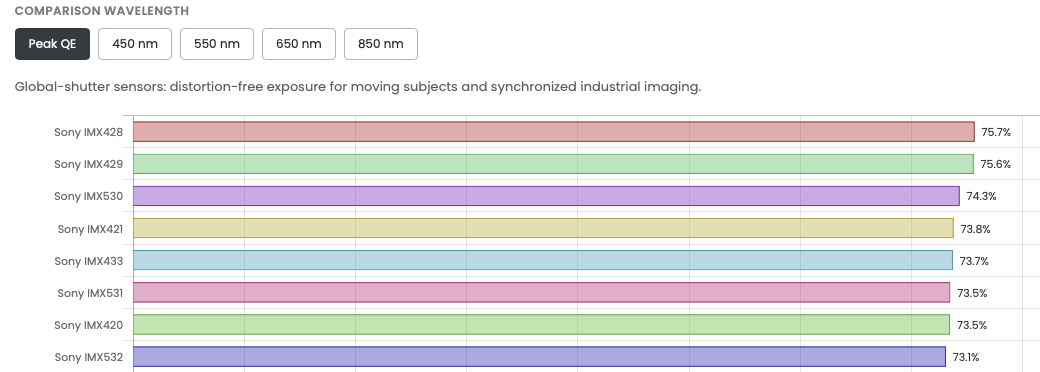
The Atlas10 SWIR cameras are based on Sony SenSWIR™ sensors, including the IMX992 (5.2 MP) and IMX993 (3.2 MP), enabling imaging from visible wavelengths up to 1700 nm.
The cameras feature a 10GigE interface with RDMA support, designed to enable high-throughput data transfer while reducing CPU load, which is relevant for multi-camera systems and data-intensive inspection setups.
An integrated thermoelectric cooling (TEC) system is used to stabilize sensor temperature during operation, supporting controlled imaging conditions in environments with varying thermal characteristics.
The Atlas10 SWIR series is built on LUCID’s Factory Tough™ platform, with an IP67-rated enclosure designed for use in industrial environments, providing protection against dust and water ingress.
Key capabilities
- SWIR imaging using Sony IMX992 (5.2 MP) and IMX993 (3.2 MP) sensors
- Spectral sensitivity from visible range up to 1700 nm
- 10GigE interface with RDMA support
- Integrated thermoelectric cooling (TEC)
- IP67-rated industrial enclosure
Typical applications
- Semiconductor and electronics inspection
- Material sorting and inspection
- Food and agricultural inspection
- Medical and life sciences imaging
- Industrial inspection systems
👉 Learn more about Atlas10 SWIR cameras on the LUCID website
👉 Contact us for pricing, availability, and technical support
New arrival
Dolor sit amet, consectetur adipisi cing elit, sed do eius mod tempor incididunt ut labore et dolore magna aliqua.